
Why Working With Couples Changes You as a Therapist

Working with Couples as a Therapist - The Atmosphere in the Room
There is a moment in couples work when the atmosphere shifts. Not necessarily dramatic, raised voices or overt hostility. Sometimes it is simply a tightening of tone, a partner leaning forward as if bracing for impact, the other withdrawing slightly, eyes fixed somewhere just beyond the conversation. And if you are watching carefully, you can see that the therapist has become part of it what ever is going on.
Many therapists first approach couples work with the assumption that it will be an extension of what they already do. If you are trained relationally, attuned to attachment, comfortable with rupture and repair, what difference does an additional chair make? Many of the theories translate across. The reality is that working with couples is not simply relational work with twice the material. The structure of the work is different. The systemic demands are different. Every intervention lands in more than one place at once; with each of the participants and the relationship they have between them. When the therapist turns towards one partner with curiosity, the other is watching. When they hold silence, it resonates differently for each person in the room. Even the smallest micro-gesture can be interpreted as alignment, withdrawal or judgement. The therapist is no longer in a dyad but in a triad, and the emotional field is dynamic.
The Immediacy
What often surprises to begin with isn't the complexity of the theory, but the immediacy of the emotional field. In individual therapy, projection and transference unfold over time. In couples work, they ignite in front of you. Attachment wounds are activated not in recollection but in interaction. Escalation can gather pace in minutes. The work is equally about containment, pacing and structure as well as interpretation.
Two dysregulated partners can activate a third - and therapists who do this work often describe it as one of the more challenging discoveries. They notice a pull towards the more visibly vulnerable partner, or an identification with the one who seems more coherent, more articulate. A desire to calm the room quickly, to restore civility, to reduce intensity. Or a retreat into studied neutrality that keeps them from feeling too implicated.
Couples work has a way of revealing the therapist's thresholds - tolerance for anger, comfort with confrontation, their relationship with power and passivity. It brings into focus aspects of practice that can remain less visible in individual work. Without a framework, this can feel exposing and wounding.
The Difference a Framework Makes
In talking with colleagues, I've noticed is that many good therapists prefer not to work with couples because they are aware that the work demands something new. Much of core training is intrapsychic. Therapists are schooled in the internal world, in narrative coherence, in developmental understanding - less often in managing live relational escalation between two people whose patterns are interlocking and mutually reinforcing.
To sit in that space requires steadiness. It requires an ability to tolerate conflict without rushing to smooth it over, to remain engaged without becoming partisan, and to intervene in ways that shift process rather than merely content. It is less about offering insight and more about shaping interaction.
When practitioners do receive grounded, structured training in couples work, the better understanding helps develop the insight required. Patterns emerge more clearly. Escalations can be tracked rather than feared. Interventions become intentional rather than reactive. And perhaps most interestingly, this clarity feeds back into individual practice. Systemic awareness sharpens.
If you are noticing more couples enquiries, or finding that individual clients' relational struggles sit at the heart of why they have approached you, you may want to consider taking training in this area - to give you the framework and support and depth needed. Ultimately, couples work does not simply add another service to your website. It alters the way you think about conflict, the way you read a room, and often, the way you understand relationship itself.
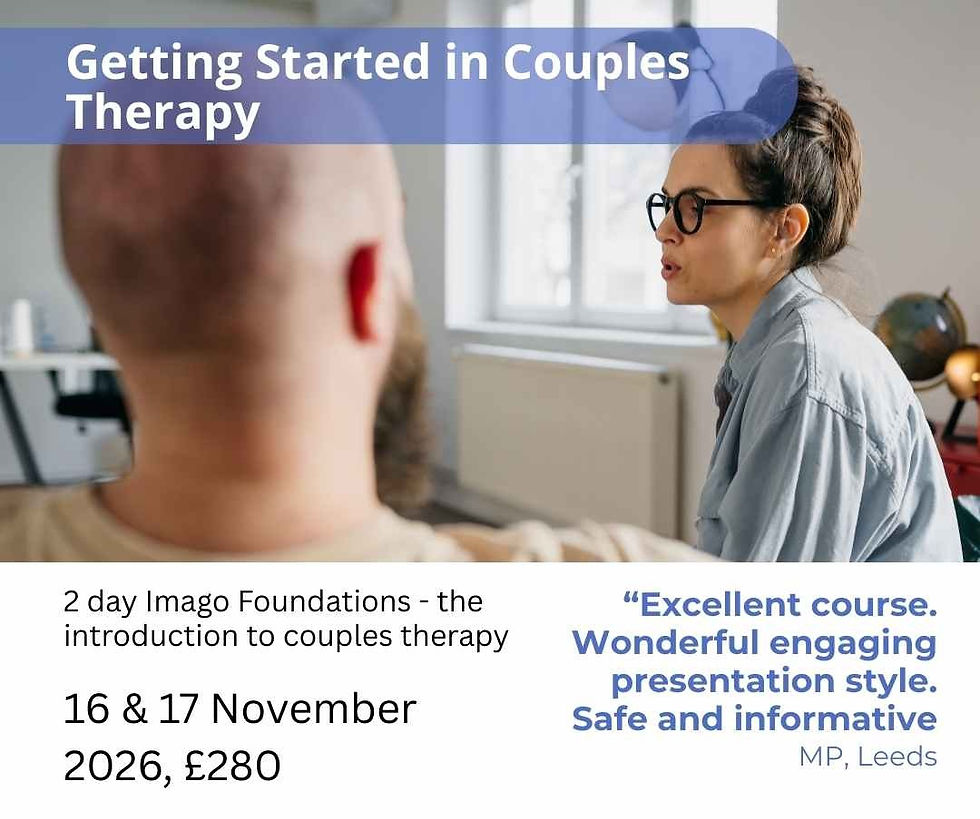
Couples dynamics is a key area on Ian Tomlinson's two-day Getting Started in Couples Therapy (Imago Foundations) training at Northside. Not as a leap into the deep end, but as a considered beginning in Imago Relationship Therapy.


Comments